
What a Skipped Fall Inspection Actually Costs
Put off garage door storm prep one more season and the bill doesn't show up as a line item — it shows up as a blown-out panel, a torn opener bracket, or water pooling under the car after a nor'easter pushes rain sideways for six hours straight. A door that limps through one storm with a bent track or loose hinge almost never survives the next one quietly. It fails louder, usually in the middle of the worst weather, when a technician is hardest to get and the damage has already spread to the drywall, insulation, or whatever's parked inside.
Why the Garage Door Is a Home's Weakest Wall
Every other wall on a house is a solid, continuous structural panel. The garage door is a large moving assembly held in place by tracks, rollers, hinges, and a handful of fasteners — and it's often the single biggest opening in the entire structure. When wind hits a house, it builds pressure on the windward side and suction on the leeward side. A door that isn't braced for that pressure differential can bow, buckle, or blow in. Once it fails, wind pressure enters the garage itself and pushes up on the roof from the inside, which is how a garage door failure turns into roof and wall damage elsewhere in the house.
This risk is higher than average on a lot of the older housing stock around northern Queens. Original doors from past decades were built to the wind-load standards of their era, not current ones, and decades of freeze-thaw cycling and road salt exposure have already weakened tracks, fasteners, and panel seams on many of them.
Pre-Storm Checklist: What to Actually Check
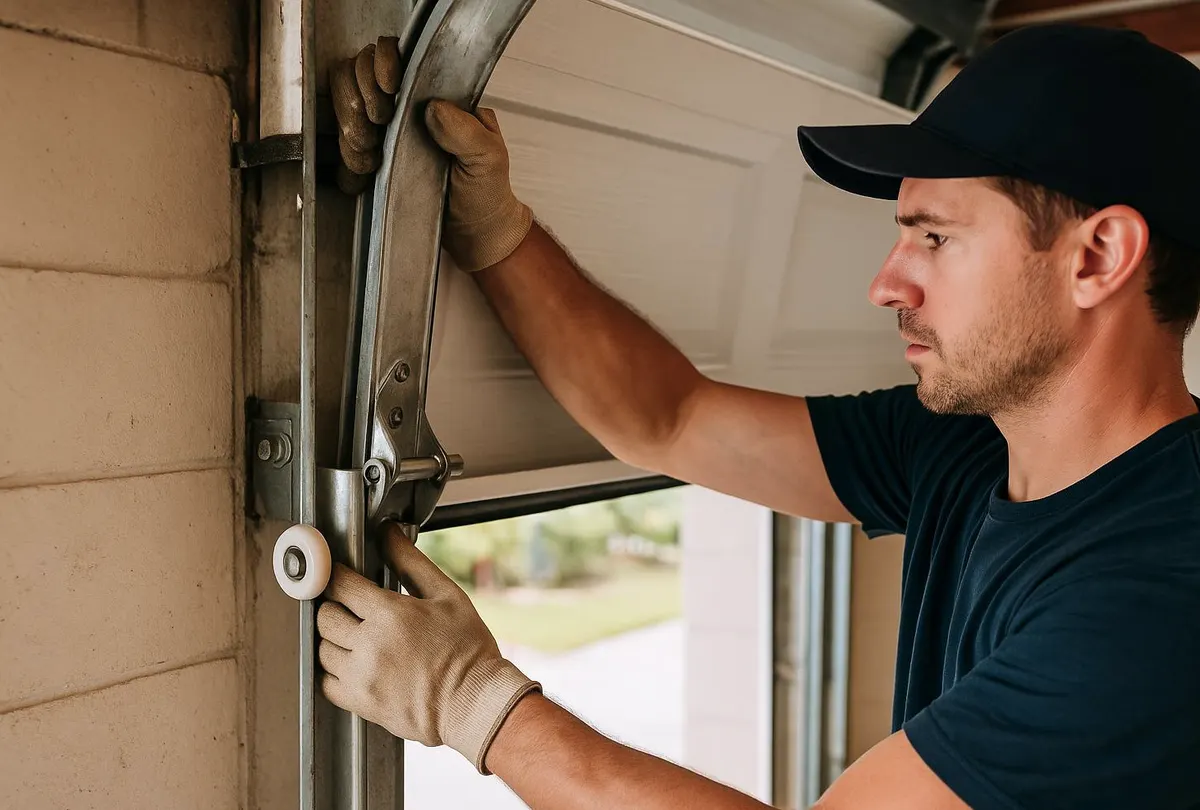
- Tracks and rollers: Look for rust, bends, or gaps between the roller and track. A track pulling away from the wall even slightly will fail faster under wind load.
- Hinges and fasteners: Tighten anything loose now. Stripped screw holes in older wood jambs are common and need to be re-anchored, not just re-tightened.
- Panels: Press on each panel. Flex, rippling, or visible bowing means the panel has already lost rigidity and won't hold up to sustained wind pressure.
- Weatherstripping and bottom seal: Cracked or flattened seals let wind-driven rain in during a nor'easter, even if the door itself holds.
- Springs: A door that's hard to lift manually, or one spring that looks stretched more than the other, is close to failure. Springs under tension fail suddenly, often during the exact moment of high wind load when the door is working hardest.
- Opener and backup power: If the power drops mid-storm and you need to get a car out, know whether your opener has a battery backup or manual release, and make sure the release cord actually works.
Reinforcement Options and Trade-Offs
For an older door that's structurally sound but not wind-rated, a horizontal or vertical bracing kit (generally a few hundred dollars installed, as a national price range) adds rigidity without replacing the whole door. It's a reasonable stopgap, but it doesn't fix rusted track or worn rollers underneath — those still need attention separately.
If the door is already showing panel fatigue, repeated track misalignment, or it's original to an older house, replacement with a wind-rated door is the more durable fix. Wind-rated doors (commonly a few thousand dollars installed, again as a national range, depending on size and material) are engineered with reinforced struts and stronger end hardware specifically to handle the pressure swings of coastal storm systems. The trade-off is upfront cost versus the ongoing risk of repairing storm damage one season after another on a door that was never built for current wind loads.
During the Storm
Keep the door fully closed and locked rather than cracked open for airflow — a partially open door catches more wind pressure, not less. If you hear new rattling, grinding, or see the door flexing visibly in gusts, stay away from it until the system has passed, then schedule an inspection before using it again.
When to Call Whitestone Garage Door
If your door is flexing, the track has pulled from the wall, or a spring looks stretched or uneven, don't wait for the next storm to test it. Whitestone Garage Door handles spring replacement and garage door repair for exactly these pre-storm problems, diagnosing worn hardware before it fails under wind load rather than after. For doors that are past reinforcing, we also handle full garage door installation with wind-rated options suited to older Queens homes.
Nor'easter season doesn't wait for a convenient weekend. Call Whitestone Garage Door today to get your door storm-ready before the next system rolls through Whitestone, NY.